 By Ilham Musyafa · June 13, 2026
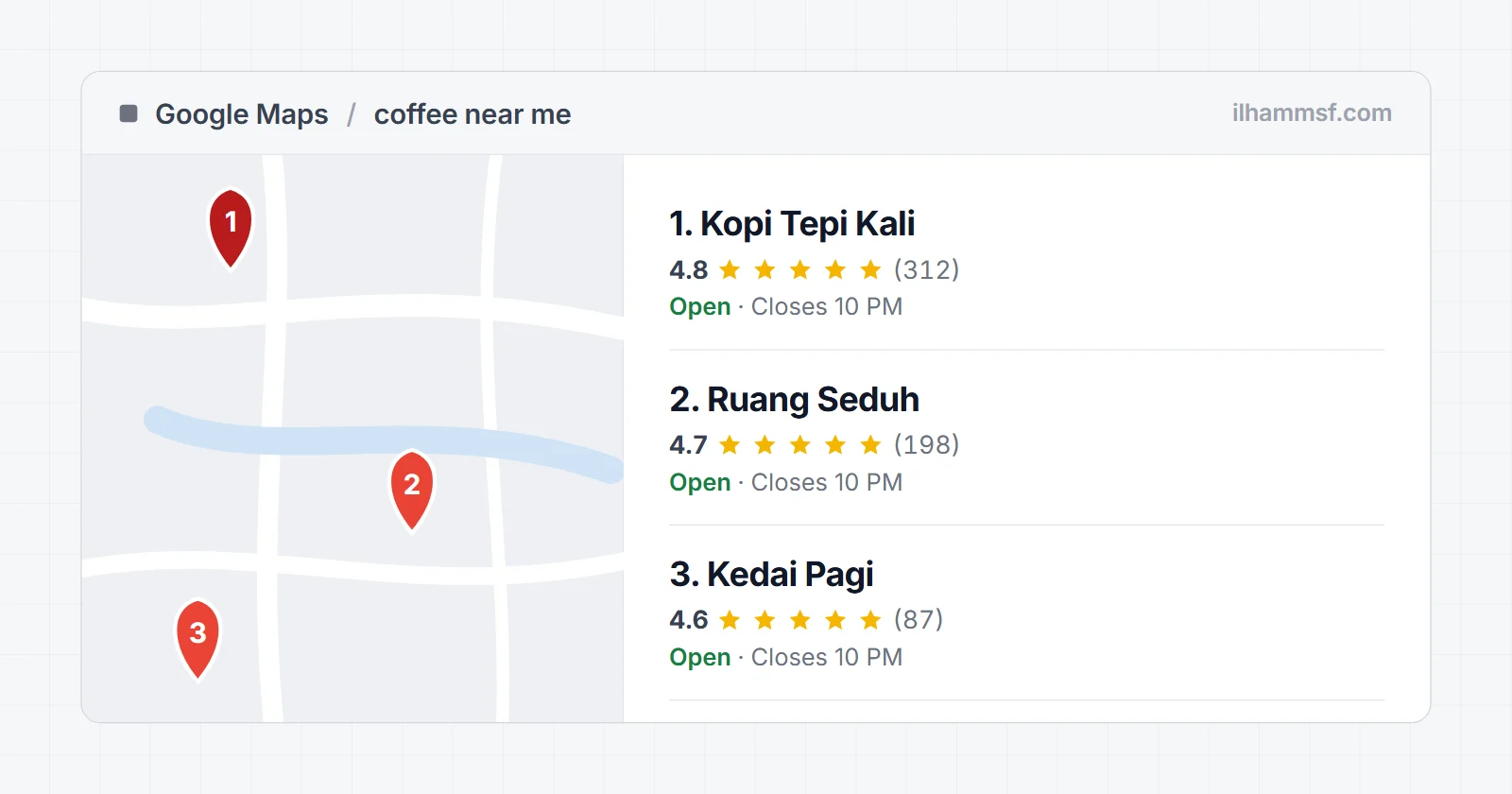
The local SEO ranking factors that matter most are the ones Google names itself: relevance (does your business match the search), distance (how close you are to the searcher) and prominence (how well known and trusted you are). In practice that comes down to a short list: a complete Google Business Profile, consistent business details across the web, a steady flow of reviews, real location pages on your website, and local links. Get those right before you spend a minute on anything clever.
Most local SEO advice is a 200-point checklist that treats every factor as equally important. They are not. I have done local SEO for US businesses at an agency and I run a small local business of my own in Jogja, so I see both the full checklist an agency sells and the handful of things an owner actually has time for. This guide is the second list, ranked, with reasons.
How Google ranks local results: relevance, distance, prominence
Google explains its local ranking in one short help page, How to improve your local ranking on Google. It names three factors, and every useful local SEO decision maps to one of them.
| Factor | What Google means | What you control |
|---|---|---|
| Relevance | How well a profile matches what someone searched for | Categories, services, description, website content |
| Distance | How far the business is from the searcher | Almost nothing, except an accurate address or service area |
| Prominence | How well known the business is | Reviews, ratings, links, mentions, real-world reputation |
Two sentences on that page are worth remembering. First, "More reviews and positive ratings can help your business's local ranking." Second, "There's no way to request or pay for a better local ranking on Google." Anyone selling a guaranteed spot in the map results is selling something Google says does not exist.
Distance is the factor you can change least. If a customer searches "laundry near me" across town, the competitor around their corner has an advantage no optimization removes. Your job is to make sure that when you are close enough to compete, nothing on the relevance or prominence side holds you back.
Map pack vs local organic results
A local search usually shows two different kinds of results, and they are ranked by different signals.
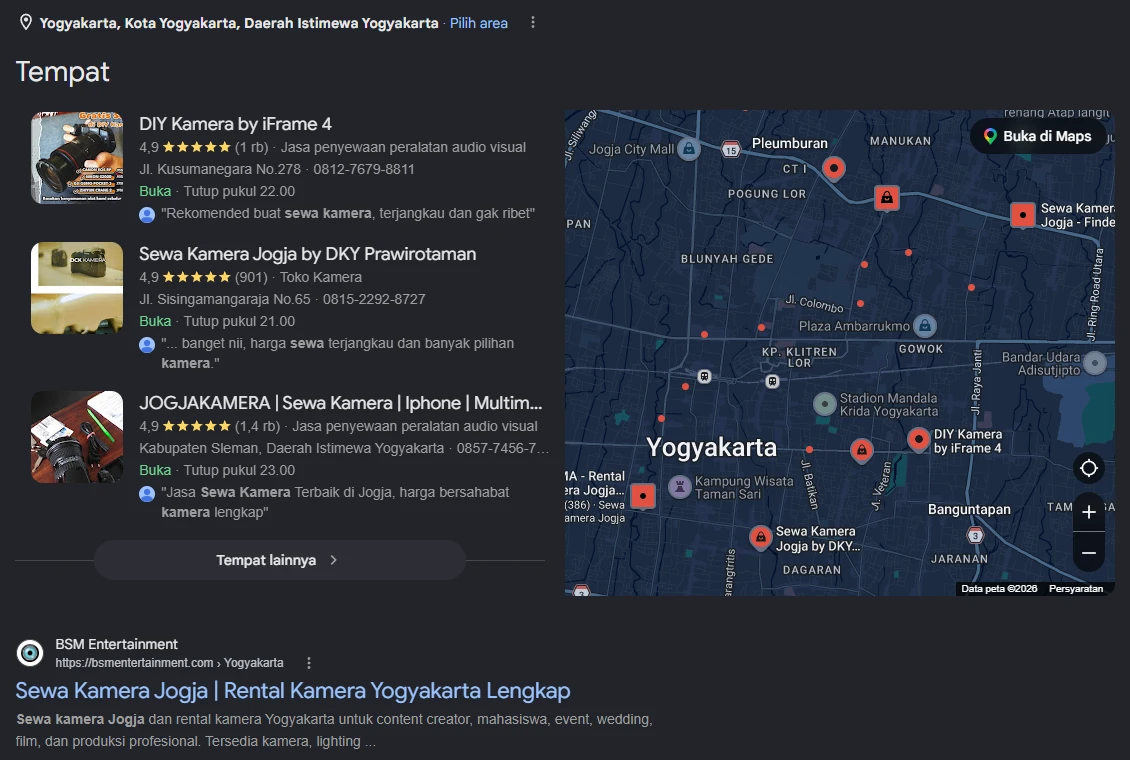
The map pack (also called the local pack or 3-pack) is built from Google Business Profiles. Your profile's categories, reviews, distance and completeness carry most of the weight here, and your website contributes through the link on the profile and through the overall prominence of the business.
The local organic results are ordinary web pages ranked for a query with local intent. Here your website does the work: a page whose title, heading and content clearly cover the service and the city, that is indexed, and that has links pointing to it.
Most small businesses need both. The map pack catches people ready to call or get directions; the organic results catch people who compare first, and queries where Google shows no map at all.
The local SEO ranking factors that matter most, in priority order
1. Google Business Profile: categories, completeness, accuracy
Your Google Business Profile is the highest-leverage thing you own in local search. It is free, and it is the data source for the map pack. Google's help page says it directly: "Businesses with complete and accurate info are more likely to show up in local search results."
What to get right, in order:
- Verification. An unverified profile is less likely to show. Google decides which verification method you are offered (video, phone, email or postcard), so start early.
- Primary category. This is the single most important relevance field. Pick the most specific category that describes your main business (a specific category such as "Tailor" beats a broad one such as "Store"). Add secondary categories only for services you genuinely offer.
- Services and products. List the actual services with plain names customers search for. This is free relevance.
- Hours, including special hours. Wrong hours on a public holiday cost you more than a ranking: they cost you a customer who drove over and found you closed.
- Description. Say what you do, for whom, and where. Write it for people. Stuffing it with keywords does not help.
- Photos. Real photos of your work, your products and (if you have one) your storefront. Stock photos add nothing.
- Website link and phone. Link to the most relevant page, which for a single-location business is usually the homepage, and for multiple locations is the matching location page.
After that, keep it accurate: new hours, a new phone number or a moved address should hit the profile the same day.
2. NAP consistency and citations
NAP means name, address and phone number. A citation is any place online where those details appear: directories, maps apps, social profiles, industry listings, the footer of your own website. When the details conflict, Google has to guess which version is right, and a business it is unsure about is a weaker candidate to show.
How to audit NAP without a paid tool:
- Write down the one canonical version: exact name, address format and phone format.
- Search Google for your business name, your phone number (in both local and international format) and any old phone number or old address.
- Open every listing you find and compare it to the canonical version.
- Fix what you control first: your website, social profiles, the big directories in your country.
- Request corrections or removal for listings you cannot edit, especially duplicates.
Which directories first: the major maps and directory platforms in your market, then industry-specific ones, then local ones (city guides, association member lists). Ten correct, relevant listings beat a hundred random ones. This is dull work, which is why most competitors skip it and why I offer citation optimization as its own service.
3. Reviews and review replies
Reviews feed prominence, and Google says so in plain words. What matters is not a single number but a pattern: a steady flow of genuine reviews, a good average rating, and visible replies.
How to ask without breaking the rules:
- Ask every customer, at the moment they are happiest (right after delivery, after a finished job), with a direct link to the review form.
- Do not offer anything in return. Google's fake engagement policy prohibits reviews posted because of an incentive, such as payment, discounts or free goods.
- Do not ask only the happy customers. The same policy prohibits selectively soliciting positive reviews.
- Do not have staff or family write reviews. That is a conflict of interest under the policy.
Reply to every review, good and bad. For a positive one, thank them by name and mention the specific thing they liked. For a negative one, acknowledge the problem without arguing and say what you changed or how to reach you directly. Future customers read your reply more closely than the complaint.
4. Location and service pages on your website (plus LocalBusiness schema)
If you serve more than one area, each area that matters deserves a real page: content that only makes sense for that location, such as how you serve it (delivery, meeting point, on-site), local details customers ask about, and reviews or photos from that area. A thin template with the town name swapped in does not count, and twenty of them can start competing with each other, which is the same problem I describe in the guide to keyword cannibalization.
On each location page (or on the homepage, for a single location), add LocalBusiness structured data whose details match your Business Profile exactly. Schema does not boost your ranking on its own, but it removes ambiguity: it tells Google in a machine-readable format which name, address, phone and hours belong together.
I build this in the schema markup generator. Choose LocalBusiness (or a more specific subtype if one fits), enter the same name, address, phone and opening hours as the profile, and it flags required fields that are still empty before you copy the JSON-LD.
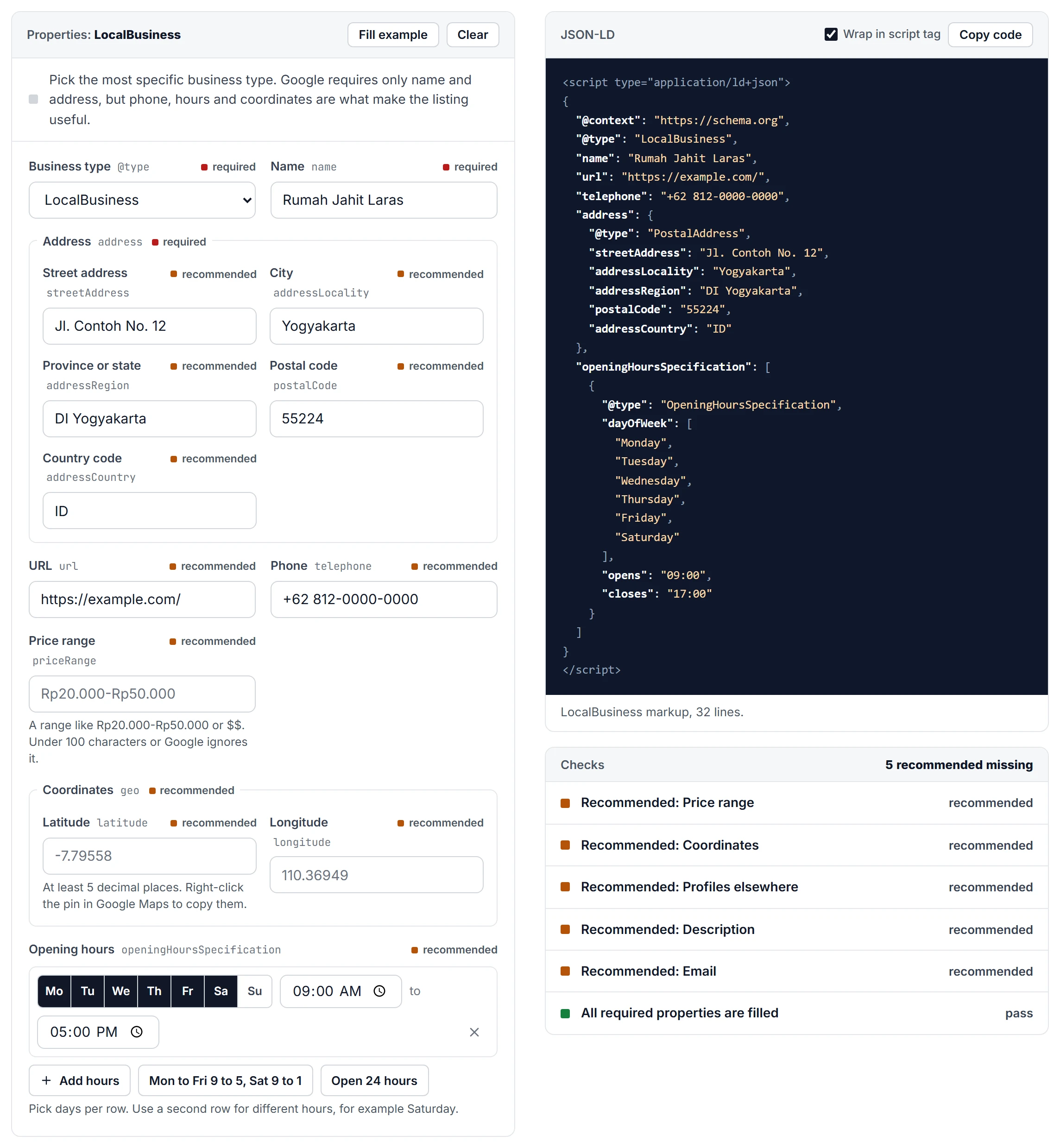
The output for that hypothetical business looks like this:
{
  "@context": "https://schema.org",
  "@type": "LocalBusiness",
  "name": "Rumah Jahit Laras",
  "url": "https://example.com/",
  "telephone": "+62 812-0000-0000",
  "address": {
    "@type": "PostalAddress",
    "streetAddress": "Jl. Contoh No. 12",
    "addressLocality": "Yogyakarta",
    "addressRegion": "DI Yogyakarta",
    "postalCode": "55224",
    "addressCountry": "ID"
  },
  "openingHoursSpecification": [
    {
      "@type": "OpeningHoursSpecification",
      "dayOfWeek": [
        "Monday",
        "Tuesday",
        "Wednesday",
        "Thursday",
        "Friday",
        "Saturday"
      ],
      "opens": "09:00",
      "closes": "17:00"
    }
  ]
}
The most common mismatch I see is the phone format. If the profile says 0812... and the schema says +62 812..., both are the same number to a human, but you are better off picking one format and using it everywhere, including the website footer.
5. Local links and mentions
Google's help page ties prominence to "how many websites link to your business." For a local business the most valuable links are local ones: a feature in a local news site, a listing on a business association or chamber of commerce site, a partner business that recommends you, a community event you sponsored, a supplier that lists its stockists.
These are harder to get than a directory listing, which is why they carry weight. A practical start: list every organization you already have a real relationship with (suppliers, partners, venues, associations) and check whether each has a page where it could mention you. Most local links come from relationships you already have, not from cold outreach.
6. Website basics that feed relevance
Your website still has to do the boring basics, because a page that is not indexed or not clear cannot help either the map pack or the organic results.
- The title and H1 of each location or service page carry the service and the city.
- The page is indexable: no stray noindex, not blocked by robots.txt, not a redirect. If a location page never shows in search at all, start with why pages are not indexed.
- Name, address and phone appear as text on the site, matching the profile.
- The page loads quickly on a phone, since most local searches happen on one.
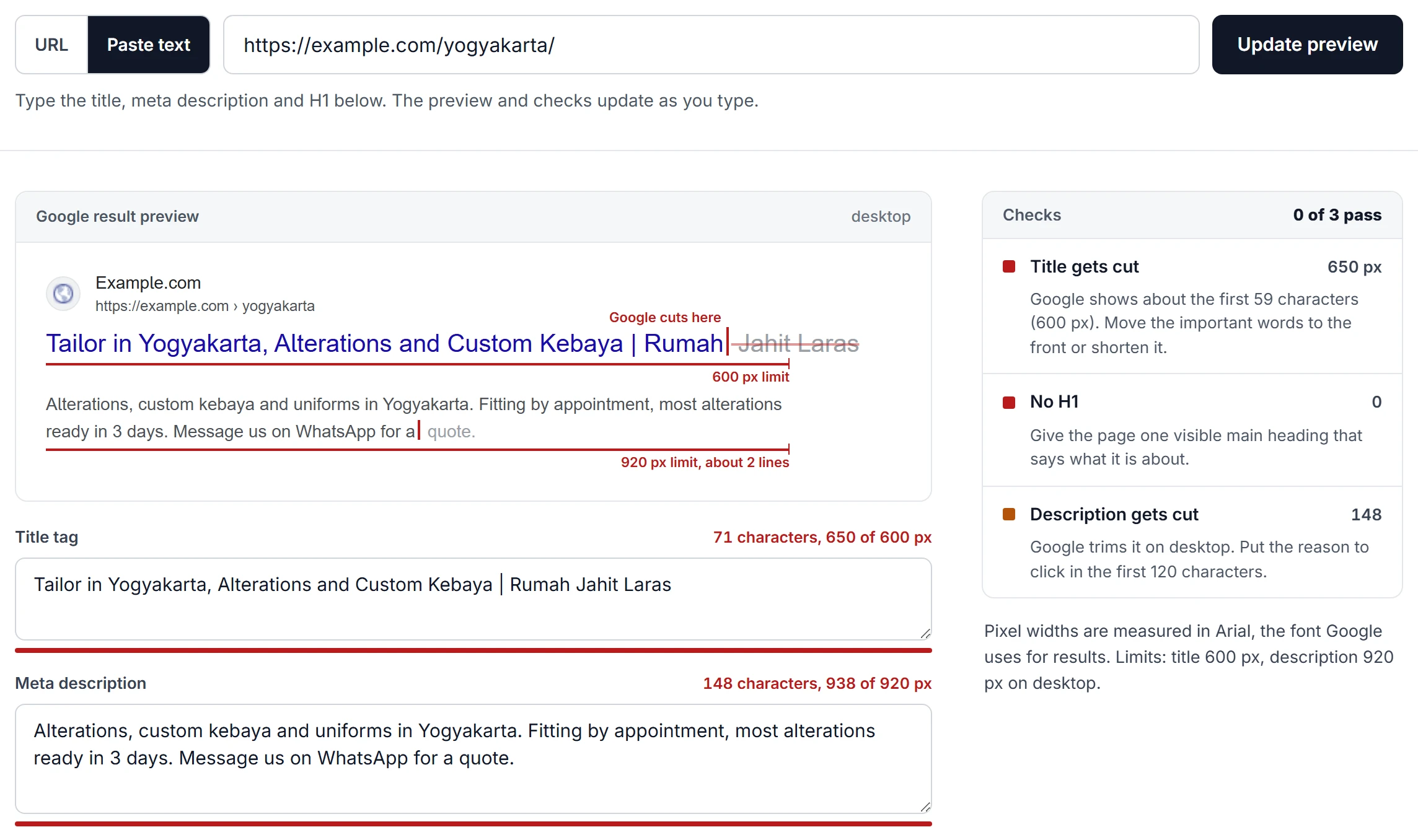
For the title, check where Google cuts it off. In the SERP preview tool, "Tailor in Yogyakarta, Alterations and Custom Kebaya | Rumah Jahit Laras" keeps the service and the city visible, while "Welcome to the Official Website of Rumah Jahit Laras, Your Trusted..." spends the whole visible width on words nobody searched for.
What matters less than you think
These are the tactics I most often see local businesses spend money or time on. Each one either barely moves rankings or carries a real risk.
- Keywords in the business name. Google's Business Profile guidelines say "Including unnecessary information in your business name isn't permitted," and list location descriptors and marketing taglines as examples. Violations can lead to suspension. Use your real-world name.
- Fake or incentivized reviews. Against policy, removable at any time, and they can take the honest reviews down with them.
- Virtual offices and fake addresses. The guidelines say a rented mailing address where the business does not operate is not eligible for a profile. A suspended profile loses everything it built.
- Duplicate profiles. One business, one profile per location. A second profile to "cover" another district splits your reviews and invites removal.
- Stuffing the service area. Listing every city in the country does not make you rank there. The guidelines say a service area should generally not extend beyond about two hours of driving from your base.
- Geotagged photos. Adding GPS data to images before uploading is a popular trick with no evidence behind it. Real photos matter; the metadata does not.
- Posting volume. Posting on the profile ten times a week does not outrank a competitor with better reviews and a closer location. Posts are useful for customers (offers, news), not as a ranking lever.
- Meta keywords and schema on its own. Google ignores the meta keywords tag. Schema clarifies your details but will not lift a weak profile.
Service-area and home-based businesses
Many local businesses have no storefront: plumbers, cleaners, tutors, caterers, mobile mechanics. Google calls these service-area businesses, and the rules are clear: "If you're a service-area business, you should hide your business address from customers." You set a service area (cities or regions) instead.
Tangkap Rasa, my own camera rental in Jogja, is this kind of business. It runs from a home base, and customers either get the camera delivered or meet at an agreed point. Nobody walks in, so publishing a home address would help no one.
What changes for a service-area business:
- Location pages describe coverage, not addresses. A page for an area you serve explains how you serve it, delivery times or meeting points, and what customers there typically need. Do not invent street addresses for areas where you have no office.
- Schema follows the profile. If the profile hides the street address, do not publish it in schema or in the footer either. You can mark up the city and region and describe the area served.
- The service area stays honest. Cover the areas you actually serve, within the distance the guidelines allow.
Where to start: a 30-day local SEO checklist
If you are starting from zero or cleaning up a neglected profile, this order gets the high-return work done first.
| Week | Focus | Tasks |
|---|---|---|
| 1 | Profile | Claim and verify, set primary category, fill services, hours, description, photos |
| 2 | NAP | Write the canonical NAP, search for listings, fix your own site and main directories |
| 3 | Reviews | Make a review link, ask every recent customer, reply to all existing reviews |
| 4 | Website | Fix titles and H1s, check indexing, add LocalBusiness schema, plan location pages |
After the first month, local links and location pages become the ongoing work. They take longer, and they are what separates businesses that stay visible from those that plateau. If you want the wider picture of your site before you start, the approach in a website audit that leads to action works for local businesses too.
How to measure local SEO progress
Local rankings change with the searcher's location, so a single "what position am I" check from your own phone is misleading. Measure outcomes instead.
- Business Profile performance. The profile's performance view shows calls, website clicks, direction requests and the search terms that showed your profile. Compare month to month, not day to day.
- Search Console queries with place names. In the Performance report, filter queries that contain your city or district name. This shows whether your website is gaining visibility for local searches.
- Tag the profile's website link. Add UTM parameters to the website URL in your profile so visits from the profile appear separately in analytics instead of blending into organic traffic. In the UTM builder, a common setup is source
google, mediumorganic, campaigngbp-listing: the visits stay in Organic Search but you can filter them out on their own. - Ask new customers. "How did you find us?" is still the most honest attribution for a small business, especially when most enquiries come by phone or chat.
Grid-based rank trackers, which check your map position from many points around your area, earn their cost when an agency manages many locations. For one business, calls, direction requests and enquiries tell you more.
Frequently asked questions
What are the three main local SEO ranking factors?
Relevance, distance and prominence. Google names these three in its help page on local ranking. Relevance is how well your profile matches the search, distance is how far you are from the searcher, and prominence is how well known and well reviewed the business is.
What is the most important local SEO ranking factor?
The primary category on your Google Business Profile is the biggest single relevance lever you control. Distance often matters more, but you cannot change where the searcher is. After the category, completeness of the profile and a steady flow of reviews do the most.
Do reviews affect local rankings?
Yes. Google states that more reviews and positive ratings can help a business's local ranking. A regular flow of genuine reviews and visible replies matters more than a sudden burst.
Is Google Business Profile more important than my website?
For the map pack, yes, because the map results are built from profiles. For the regular results below the map, your website matters more, so most local businesses need both.
Can I rank in a city where I do not have an address?
In the map pack it is hard, because distance is part of the ranking and a fake address breaks Google's guidelines. In the organic results you can, with a genuine page about how you serve that city.
Does putting keywords in my business name help?
It is against the Business Profile guidelines, which do not permit unnecessary information in the name. It can get the profile suspended. Use the name you use on your sign, invoices and social profiles.
Can I pay Google for a better local ranking?
No. Google says there is no way to request or pay for a better local ranking. Ads can appear above the map results, but they are labeled as ads and do not change the organic local ranking.
How long does local SEO take to work?
Profile fixes such as a corrected category or hours can show an effect within weeks once Google processes them. Reviews and local links build over months. Measure monthly and judge the trend over a quarter, not a week.
Not sure which of these signals is weak for your business? A website audit shows exactly where you stand, or get in touch and I will take a look.