 By Ilham Musyafa · November 10, 2026
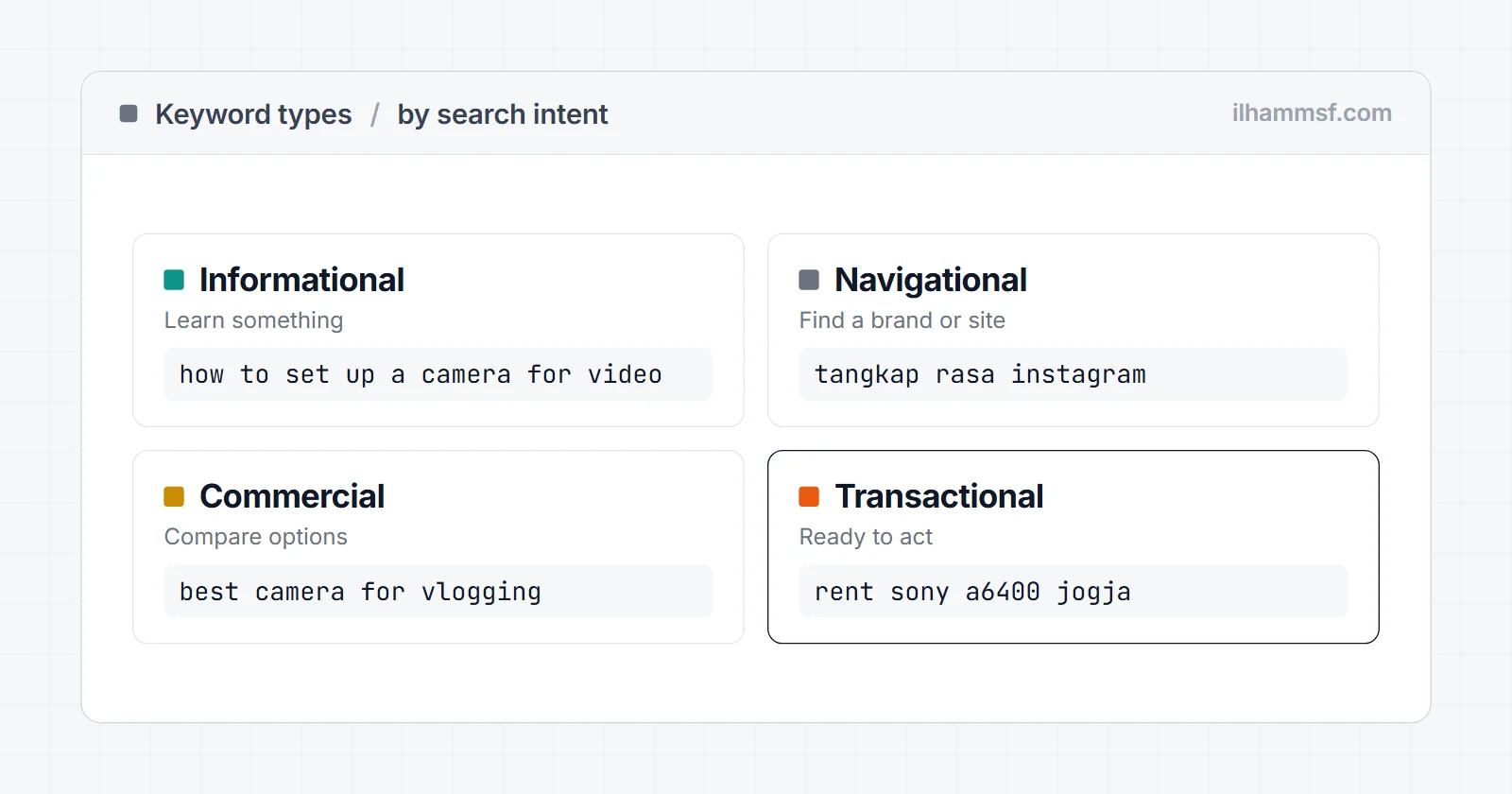
Keywords are the words people type into Google. Sorting them into types is how you decide which page should target which search, and what that page needs to say. The most useful way to group them is by search intent (what the person wants), then by length (how specific the search is). Everything else, such as branded, local or question keywords, sits on top of those two.
Below are the main types of keywords in SEO, each with examples from one business, so you can see how they fit together: a camera rental shop in Yogyakarta.
The types at a glance
| Type | What it tells you | Example |
|---|---|---|
| Informational | The searcher wants to learn something | how to set up a sony a6400 for video |
| Navigational | The searcher wants a specific site or brand | tangkap rasa camera rental |
| Commercial | The searcher is comparing options | best mirrorless camera for vlogging |
| Transactional | The searcher is ready to act | rent sony a6400 jogja |
| Short-tail | Broad, high volume, vague intent | camera rental |
| Long-tail | Specific, lower volume, clear intent | rent camera for wedding in jogja 3 days |
| Branded | Contains your brand or a competitor's | tangkap rasa price list |
| Local | Contains a place or "near me" | camera rental near me |
| Question | Phrased as a question | how much does it cost to rent a camera |
Keyword types by search intent
Search intent is the reason behind a search. Google tries to show the kind of page that matches it, so a page that answers the wrong intent rarely ranks, however well it is written.
1. Informational keywords
The person wants an answer, a guide or an explanation. They are not ready to buy.
Examples: how to record video on a mirrorless camera, what is shutter speed, sony a6400 settings for video.
Best page type: a blog post or guide. Most of what ranks here is educational content, not a product page.
2. Navigational keywords
The person already knows where they want to go and uses Google as the shortcut.
Examples: tangkap rasa instagram, bibit login, google search console.
Best page type: your homepage, a login page, or a contact page. You usually only win navigational searches for your own brand.
3. Commercial keywords
The person is researching before buying: comparing products, reading reviews, looking for the best option.
Examples: best camera for vlogging 2026, sony a6400 vs canon r50, dji pocket 3 review.
Best page type: a comparison, a review, or a "best of" list. This is where a buyer forms an opinion, so honest comparisons work better than a sales page.
4. Transactional keywords
The person is ready to do something now: buy, book, rent, sign up, call.
Examples: rent sony a6400 jogja, camera rental price per day, book camera rental online.
Best page type: a product, service or booking page with a price and a clear next step. These keywords bring fewer visitors than informational ones but far more customers.
Some guides group the four intent types into just "informational" and "commercial", or call transactional keywords "buyer keywords". The labels change. The idea is the same.
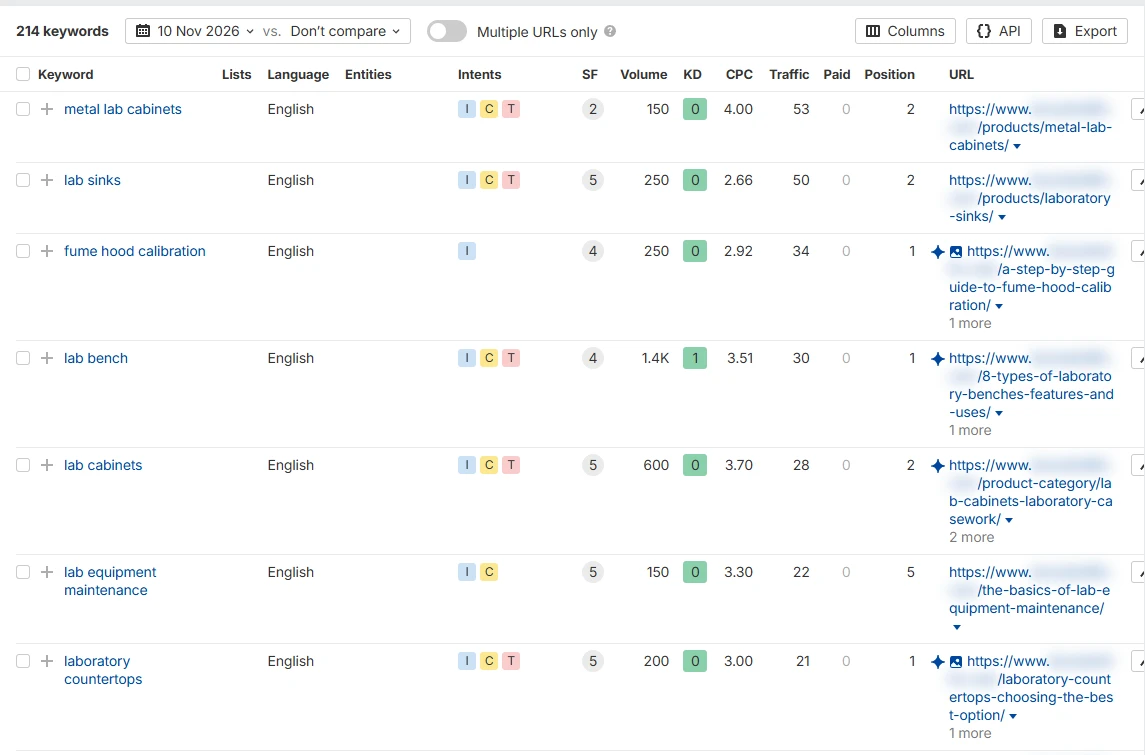
SEO tools label intent for you. Here is Ahrefs on a client site I manage (lab furniture, domain hidden). Look at the Intents column: lab sinks is tagged I, C and T at once, while fume hood calibration is purely I, informational, and the page that ranks for it is a step-by-step guide, not a product page.
Keyword types by length
Short-tail keywords
One or two words, often called head terms. High search volume, high competition, and the intent is unclear: someone searching camera rental could want a shop, a price, a comparison, or a definition.
Examples: camera rental, mirrorless camera, seo.
Long-tail keywords
Three or more words, usually more specific. Each one has a small search volume, but together they make up most searches, and the intent is much clearer.
Examples: rent camera for wedding in jogja, camera rental with drone package, how to rent a camera without a credit card.
For a new or small site, long-tail keywords are where you start. They are easier to rank for, and the people searching them know what they want. The keyword generator pulls hundreds of long-tail ideas from Google autocomplete in one go, and guesses the intent of each one:
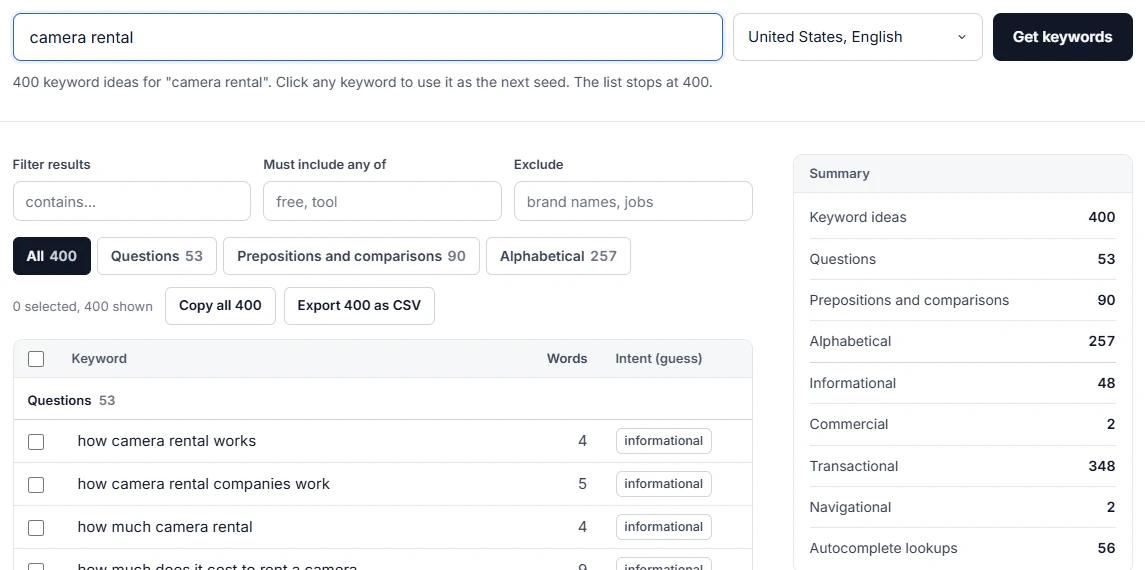
Notice the split for camera rental: the tool tags 348 of the 400 autocomplete suggestions as transactional and only 48 as informational. People who type this phrase mostly want to rent, not learn, which tells you the main page for it should be a rental page with prices, not a blog post.
Keyword types by funnel stage
Marketers often map keywords to the stages of a buyer's journey. It overlaps with intent, but it helps when planning content:
| Stage | Intent | Example |
|---|---|---|
| Top of funnel (awareness) | Informational | what camera do I need for youtube |
| Middle of funnel (consideration) | Commercial | rent or buy a camera for a one-time event |
| Bottom of funnel (decision) | Transactional | camera rental jogja price list |
A site that only has bottom-of-funnel pages misses the people who are still deciding. A site that only has blog posts gets readers but no bookings. You want a few pages at each stage, linked to each other.
Other types of keywords worth knowing
Branded and non-branded keywords
Branded keywords contain a brand name: yours (tangkap rasa) or a competitor's (competitor name camera rental). Non-branded keywords do not (camera rental jogja). Branded searches show how well people know you. Non-branded searches are where new customers find you.
Local keywords
Keywords with a city, area or "near me": camera rental near me, sewa kamera sleman. They trigger the map pack and local results, so your Google Business Profile matters as much as your website here.
Question keywords
Searches phrased as questions: how much does camera rental cost, can I rent a camera without a deposit. They are perfect for FAQ sections and often show up in "People also ask" boxes. In Search Console you can filter your queries with a regex like ^(how|what|why|can|does|which|where|is|are) to find the ones you already appear for:
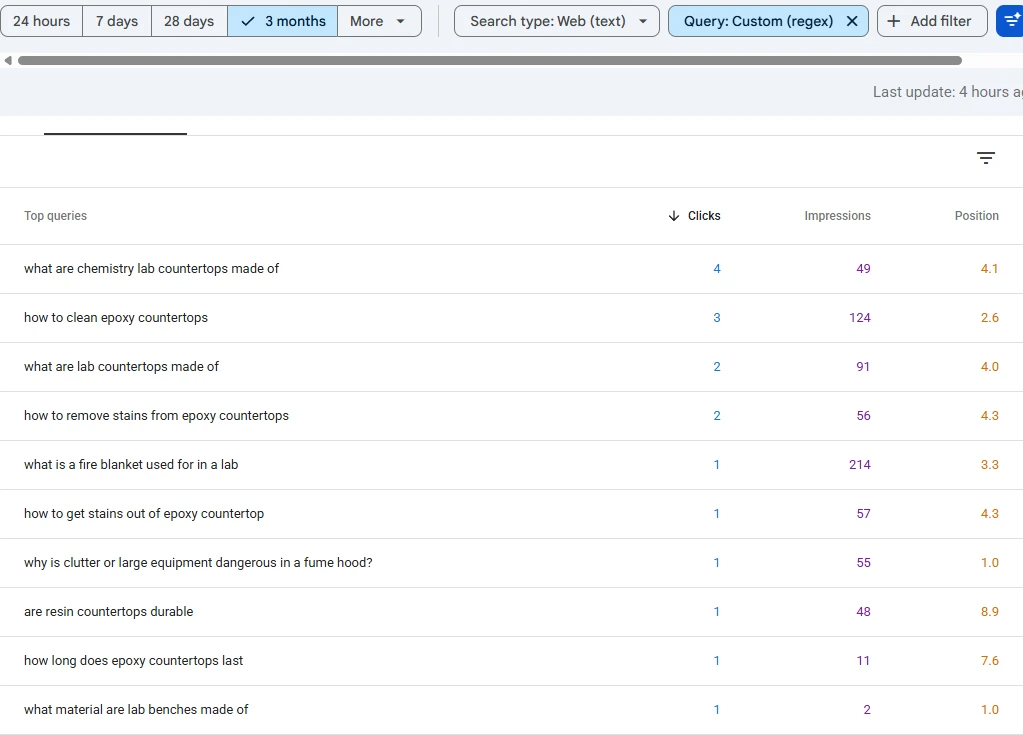
Each of those is a ready-made FAQ heading or a short guide. how to clean epoxy countertops already sits at position 2.6, so the page answering it is doing its job. are resin countertops durable sits at 8.9, which is a sign the answer could be clearer.
Product and service keywords
The exact names of what you sell: sony a6400, dji osmo pocket 3, website audit. Each one usually deserves its own page.
Seasonal and trending keywords
Searches that peak at certain times: camera rental for graduation around graduation season, ramadan video ideas before Ramadan. Publish or update those pages a few weeks before the peak.
What about LSI keywords?
You will see "LSI keywords" in many guides. Google has said it does not use latent semantic indexing. What actually helps is covering the topic properly, which naturally brings in related terms. Do not chase a list of "LSI words".
Topics vs keywords
A keyword is one search. A topic is the subject behind a group of searches that want the same answer. types of keywords, keyword types with examples and different kinds of keywords in seo are three keywords, one topic, one page.
Modern SEO plans by topic: you pick the topic, choose the main keyword for the title, and use the variations naturally in headings and copy. If you write a separate page for every variation, your pages compete with each other, which is keyword cannibalization.
Why track keywords?
Once a page targets a keyword, tracking its position tells you whether the work is paying off and warns you when a competitor or a Google update moves you down. You can do it for free in Search Console, as explained in how to see what keywords a website ranks for.
How to choose the right keyword type for a page
- Start from the page's job. A booking page needs a transactional keyword. A guide needs an informational one.
- Check the search results. Search the keyword and look at what ranks. If the top ten are all blog posts, a product page will struggle, and the other way round.
- Prefer long-tail when your site is young. Lower competition and clearer intent mean faster results.
- One main keyword per page. Group the variations of the same intent on that page instead of splitting them.
- Write for the person, then check the basics. Paste your draft into the content SEO checker to see whether the keyword appears in the title, headings and first paragraph.
If you want a full keyword plan built from your competitors' rankings, that is what the keyword research service covers.
Frequently asked questions
What are the main types of keywords in SEO?
By search intent there are four: informational, navigational, commercial and transactional. By length there are two: short-tail and long-tail. Branded, local, question, product and seasonal keywords are extra labels on top of those.
What is an example of a keyword?
Any search someone types into Google. camera rental jogja, how to check website traffic and best mirrorless camera are all keywords.
What are website keywords examples for a small business?
For a local service business: the service plus the city (camera rental jogja), the service plus a qualifier (camera rental for wedding), price searches (camera rental price per day) and questions customers ask (do I need a deposit to rent a camera).
What is the difference between short-tail and long-tail keywords?
Short-tail keywords are one or two broad words with high volume and unclear intent. Long-tail keywords are longer and more specific, with less volume but clearer intent and easier rankings.
Which keyword type converts best?
Transactional keywords, because the searcher is ready to act. They bring fewer visitors, but a much higher share of them become customers.
Are topics and keywords the same thing?
No. A keyword is one search. A topic groups many keywords with the same intent, and one page should cover the whole topic.