 By Ilham Musyafa · December 7, 2024
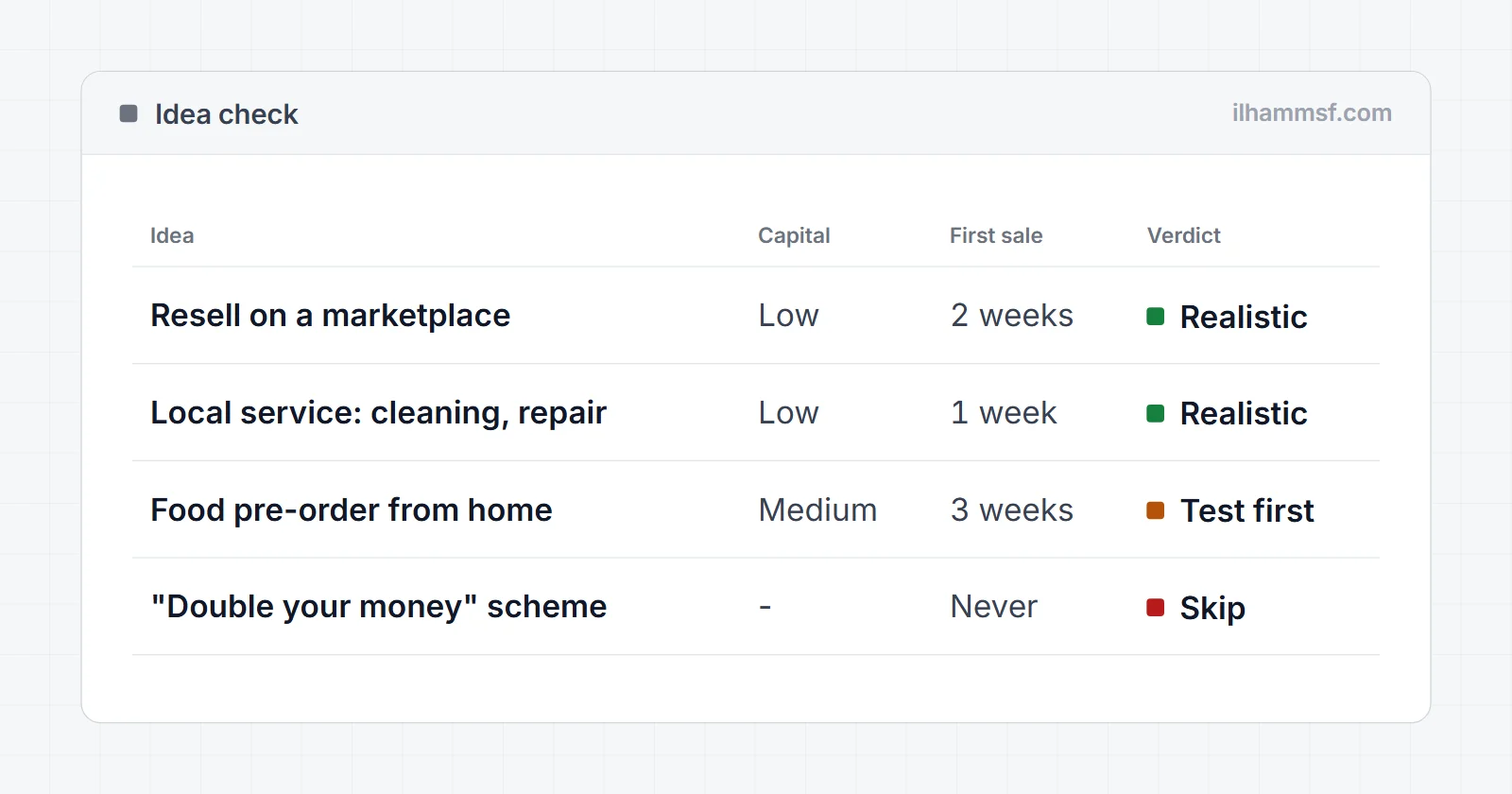
The best cash flow business ideas are boring on purpose: you sell a skill, a service or the use of something you already own, to people who already pay for it, and you can take the first payment within weeks. That is what "quick cash business" honestly means. Nothing on this list will make you rich quickly, and anyone who promises that is selling you something. What these ideas can do is get money moving in your direction fast, cover their own costs early, and give you a base to build on.
What "quick" and "cash flow" realistically mean
Cash flow means money comes in on a regular rhythm, not once: customers pay soon after the work, and they come back without you finding them again. Laundry, tutoring and rentals have this. A one-off big project does not, even if it pays well.
Quick has two honest milestones. The first is time to first sale: how many days or weeks until a stranger pays you. The second is break-even: how many months until the business has paid back what you put in. Fast businesses shorten both, and they do it through three things:
- Low startup cost. Less money in means less money to earn back.
- Existing demand. You sell something people already search for and pay for, so you are not educating a market.
- A skill or asset you already have. You skip the learning curve and the purchase.
Wealth is a third, much later milestone, built from what you do with the cash flow over years.
Comparison: startup cost, time to first sale and risk
The table below compares the ideas in this guide. Startup cost is a level, not an amount, because the real figure depends on your city and what you already own. Time to first sale assumes you start selling to your own network and local channels in week one.
| Idea | Startup cost | Time to first sale | Risk | Repeat income |
|---|---|---|---|---|
| Freelance skill (design, writing, video) | Low | Days to weeks | Low | Medium |
| Tutoring and lessons | Low | Days to weeks | Low | High |
| Cleaning, laundry, home services | Low to medium | Weeks | Low to medium | High |
| Local photo and video | Medium | Weeks | Low to medium | Low to medium |
| Home food and snacks | Low to medium | Days to weeks | Medium | High |
| Reselling and dropshipping | Low | Weeks | Medium | Medium |
| Digital products | Low | Weeks to months | Low | Medium |
| Equipment rental | Medium to high | Weeks | Medium | High |
| Franchise | High | Months | Medium to high | High |
| Property | High | Months to years | Medium to high | High |
Top rows trade your time for money: cheap to start, but income stops when you stop. Bottom rows need capital but can earn without your hours. Most people should start near the top and use the cash flow to move down.
Service ideas with the shortest runway
Selling a skill is the fastest route to first income because there is almost nothing to buy. Your costs are a phone, a way to get paid, and a way to be found.
Freelance skills
Design, writing, editing, bookkeeping, coding, video editing. If you can already do the work, your first client usually comes from people who know you, not from a marketplace. Message ten people who run small businesses, show two or three samples, and offer one specific, fixed-price job ("I will redo your menu as a printable PDF and an Instagram post").
Tutoring and lessons
Languages, school subjects, music, software. Demand repeats every week, parents refer other parents, and the only capital is what you know. Start with a fixed weekly slot and a small package of sessions paid upfront, which gives you cash flow before you have taught a single lesson.
Cleaning, laundry and home services
House cleaning, car washing, laundry pickup, garden work. Unglamorous, which is why they work: demand is daily and a reliable provider gets rebooked. A laundry with machines needs real capital; a pickup service partnered with an existing laundry needs almost none.
Local photo and video
Product photos for small shops, event coverage, short videos for local businesses. If you already own a decent camera, the cost is mostly your time, and a monthly content package turns one-off jobs into cash flow.
Product and resale ideas
Home food and snacks
Food is bought daily, which makes it one of the best repeat-income categories. Start with one product you make consistently well, sell it to offices, schools or your neighbourhood on fixed days, and take orders in advance so you never cook for buyers who do not exist. Check your local rules on home food production and labelling before you scale.
Reselling and dropshipping
You find the buyer, a supplier holds the stock. Capital is low but so are margins, and competition is heavy because everyone can sell the same item. This model lives or dies on marketing and on picking a narrow niche where you understand the buyer better than the big sellers do.
Digital products
Templates, guides, presets, small courses. You build once and sell many times, but time to first sale is longer because you have to make the product, then find an audience. It works best as a second step for someone who already sells a related service.
Asset and rental ideas
Rentals sit between services and products: you buy the asset once and get paid each time someone uses it. Cameras, sound systems, tools, camping gear, vehicles, party equipment. The model works when the item is expensive to buy, needed only occasionally, and easy to inspect on return.
I run a camera rental business in Jogja, Tangkap Rasa, and the lesson I would pass on is that the asset is the easy part. The work is in the system around it: a booking form so you do not double-book a unit, a deposit or ID rule to protect the gear, a clear schedule for delivery and return, and a quick way to confirm payments. I built those tools myself because a spreadsheet stopped being enough once bookings overlapped. You do not need custom software on day one, but you do need written rules before the first rental, not after the first damaged item.
Rental has higher startup cost and real risk (damage, theft, late returns), so start with one or two units you already own or can buy without debt, and add units only when demand shows up in your booking calendar.
Ideas that build wealth but take longer
Property, franchises and investing are how cash flow eventually becomes wealth, but none of them are quick, and all of them punish beginners who borrow to get in.
- Franchise. A known brand and a tested system lower the risk of the idea, but fees and fit-out are high. Ask current franchisees, not the sales team, how long they took to break even.
- Property. Rental property pays monthly, but it needs a large deposit, and vacancies or repairs can wipe out a year of profit.
- Investing. Long-term investments like index funds are a place for surplus cash flow, not a way to get rich quickly.
Treat these as the next step once a small business pays you reliably.
How to validate an idea in 7 days
Before you spend real money, spend a week proving that strangers will pay. This checklist works for almost every idea above.
- Day 1: write one sentence describing who you serve, what you do and what it costs.
- Day 2: check what people actually search for around the idea (method below).
- Day 3: list five competitors near you, their prices and what reviewers complain about.
- Day 4: build the smallest offer you can deliver this week, at a fixed price.
- Day 5: show it to 20 people who match your customer, in person or by message.
- Day 6: ask for a deposit or pre-order, not a "sounds interesting".
- Day 7: count paid commitments and decide: continue, change the offer, or drop it.
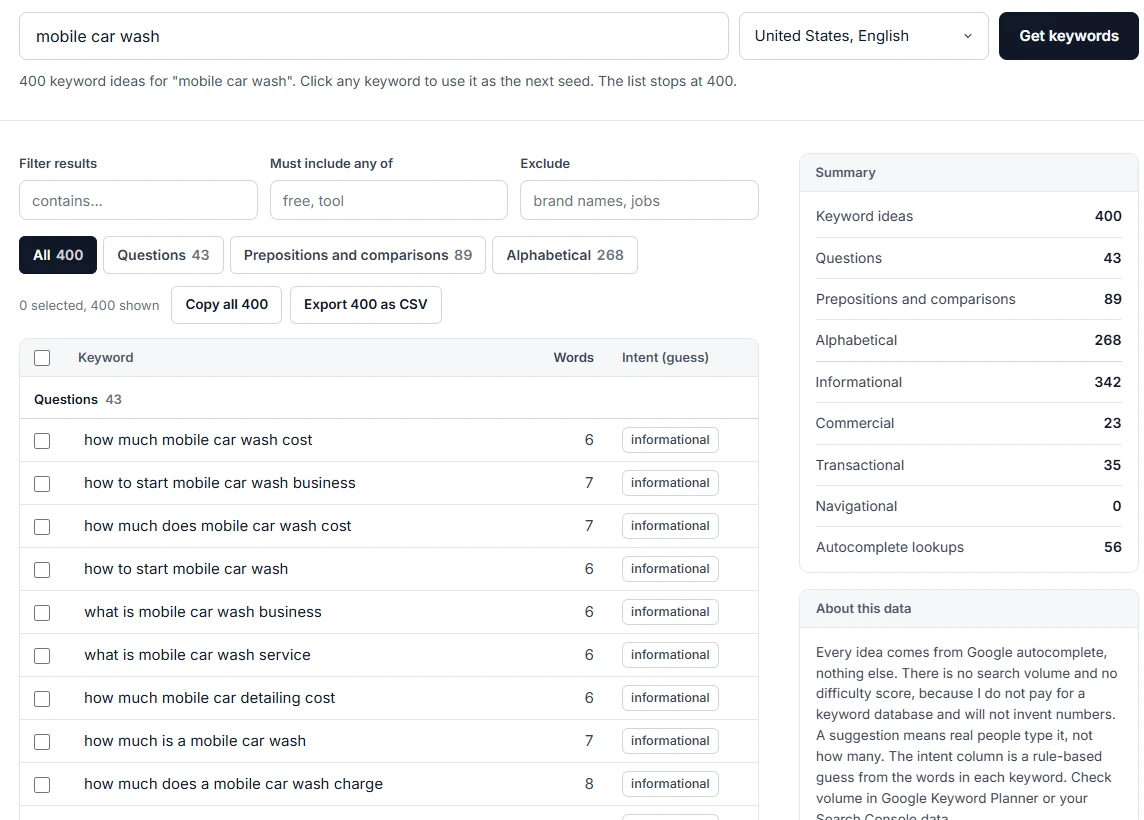
The search check on day 2 is free and takes ten minutes. Type your idea plus your city into the keyword generator, which collects Google autocomplete suggestions for a seed phrase. Autocomplete reflects what people type, so the modifiers that come back tell you how buyers think. If "mobile car wash" returns phrases like "near me", "prices" or "at home", people are actively looking to buy. If the seed returns almost nothing, demand may be thin, or people call the service something else, so try other names before you give up.
Switch to the Questions tab as well: questions like "how much does..." are objections you will hear from customers, so answer them in your offer.
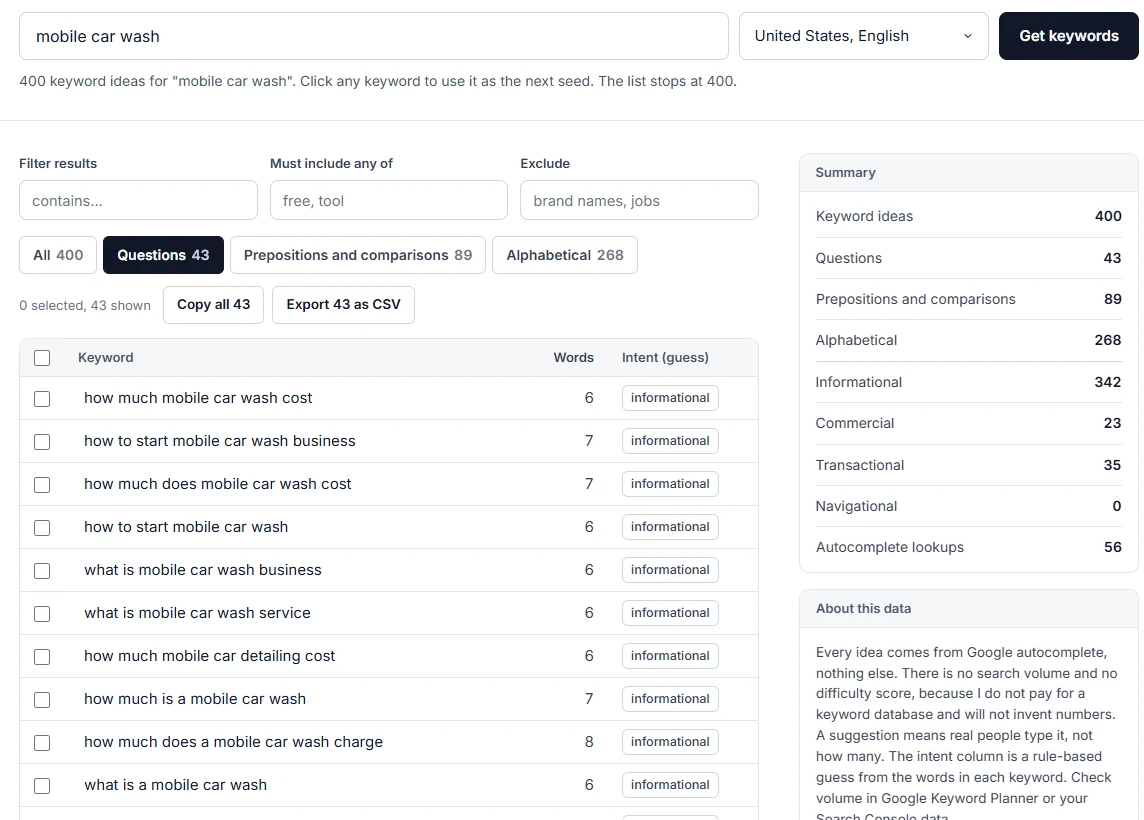
The tool shows what people type, not how many, so treat it as a direction check. The real proof is still day 6: money changing hands.
Red flags: get rich quick schemes to avoid
Searches for "get rich quick ideas" attract the people most likely to be targeted, so it is worth knowing the patterns. Walk away when you see these:
- Guaranteed returns. Any promise of a fixed high profit with no risk. Real businesses and real investments can lose money.
- Recruiting is the product. If you earn mainly by signing up other people rather than selling to customers, the model depends on an endless supply of new recruits. That is how pyramid schemes collapse.
- Pay to learn the secret. Expensive courses, coaching or "systems" sold by people whose main income is selling the course.
- Pressure and lifestyle as proof. "Only today", "spots almost full", and screenshots of cars and balances instead of a product and customers you can inspect.
- Returns paid from new deposits. Early members get paid on time, which builds trust, until new money stops. The SEC's investor education site explains how Ponzi schemes work and what warning signs to look for.
- Trading bots and signals with promised win rates. If a strategy reliably printed money, nobody would sell it to strangers.
A simple test: ask who the paying customer is and what they get. If the answer is "the next person who joins", it is not a business.
What makes a fast business stick
Getting the first sale is the quick part. Turning it into cash flow takes a few habits that are dull and effective.
- Write your rules down early. Prices, deposits, cancellations. Clear rules prevent most disputes.
- Make it easy to be found and to buy. A Google Business Profile, a WhatsApp or contact number that gets answered, and a simple page that shows prices, examples and how to book. The local SEO signals that matter for a small service business are mostly free to set up.
- Reinvest the first profit. Put early earnings back into whatever removes the bottleneck: a second unit, better equipment, a part-time helper.
- Track repeat customers. A business with returning customers has cash flow; one that needs new strangers every week is still a hustle.
- Be consistent. Most small businesses fail from stopping, not from a bad idea.
You may not need a website on day one; a social profile and a Google Business Profile can carry the first customers. Once people keep asking for prices and availability, a simple site starts saving you time. In the website cost calculator, compare a one-page landing page with a template against a 5-page small business site, then add online booking, and set the totals against what one month of the business is expected to bring in.
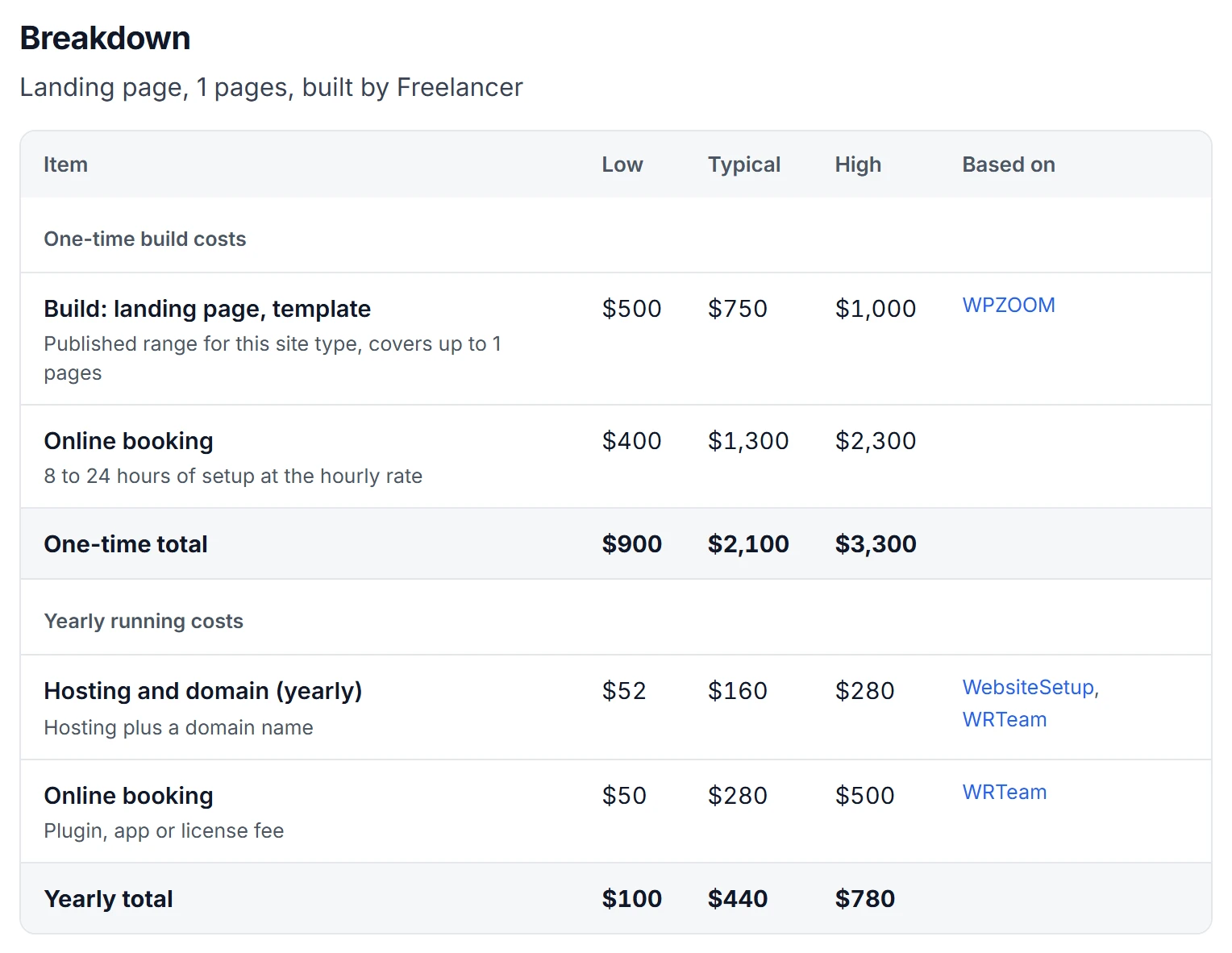
If the site would cost more than a few months of expected revenue, start with the free profiles and decide later. For getting the first product in front of buyers, see how to market a product.
Frequently asked questions
What business can I start to make quick money?
Start with a service you can already deliver: tutoring, a freelance skill, cleaning, or local photo and video. These need almost no capital, so the first payment is mostly profit. Sell to people you know first, then ask each happy customer for a referral.
Which business makes you rich the fastest?
None reliably. Businesses that grew very fast usually combined years of preparation, capital and luck, and you only hear about the ones that survived. A realistic goal is a business with fast cash flow that you then grow and reinvest over years.
What is the easiest business to start with little money?
Selling a skill you already have is the cheapest start, because the main cost is your time. For cash flow, pick one with repeat customers, such as tutoring, laundry pickup or home food on fixed weekly orders.
Can you really get rich quick with a business?
Almost never, and the people who say you can are usually selling a course, a scheme or an investment. A business can earn quickly, but wealth comes from running it well and reinvesting for years.
How long does a small business take to become profitable?
It depends on startup cost and margins. A skill-based service can be profitable from the first job because there is little to pay back, while rental or a franchise may take many months to recover the initial spend. Track it monthly so you know where you stand.
Do I need a website to start a small business?
Not on day one. A Google Business Profile and a responsive WhatsApp or phone number can bring the first customers. A simple website becomes worth it once people keep asking for prices, examples and availability.
If you are building one of these and want help looking credible online, or need a booking form or tool to run it, tell me what you are working on. A simple company profile website is often the first step.